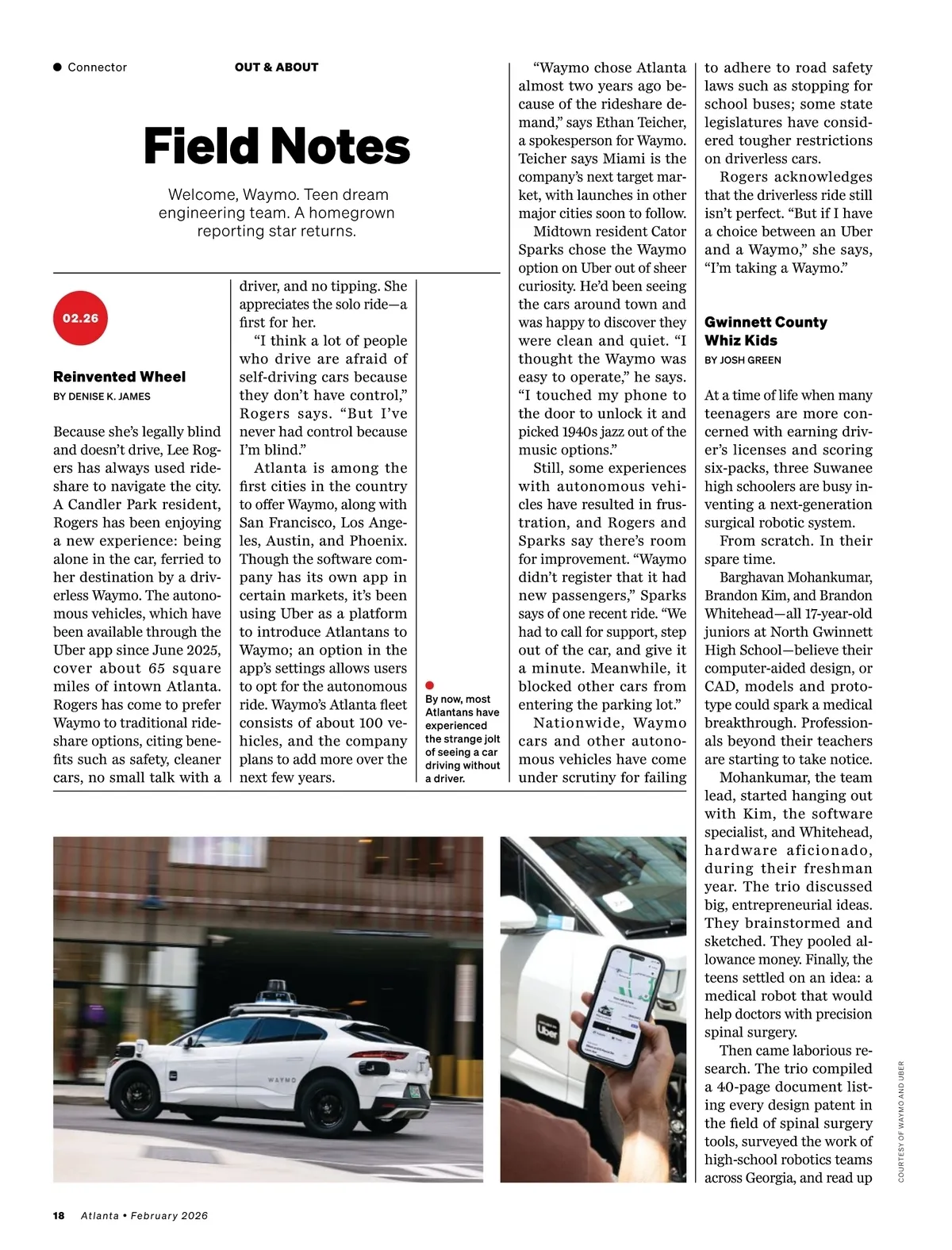
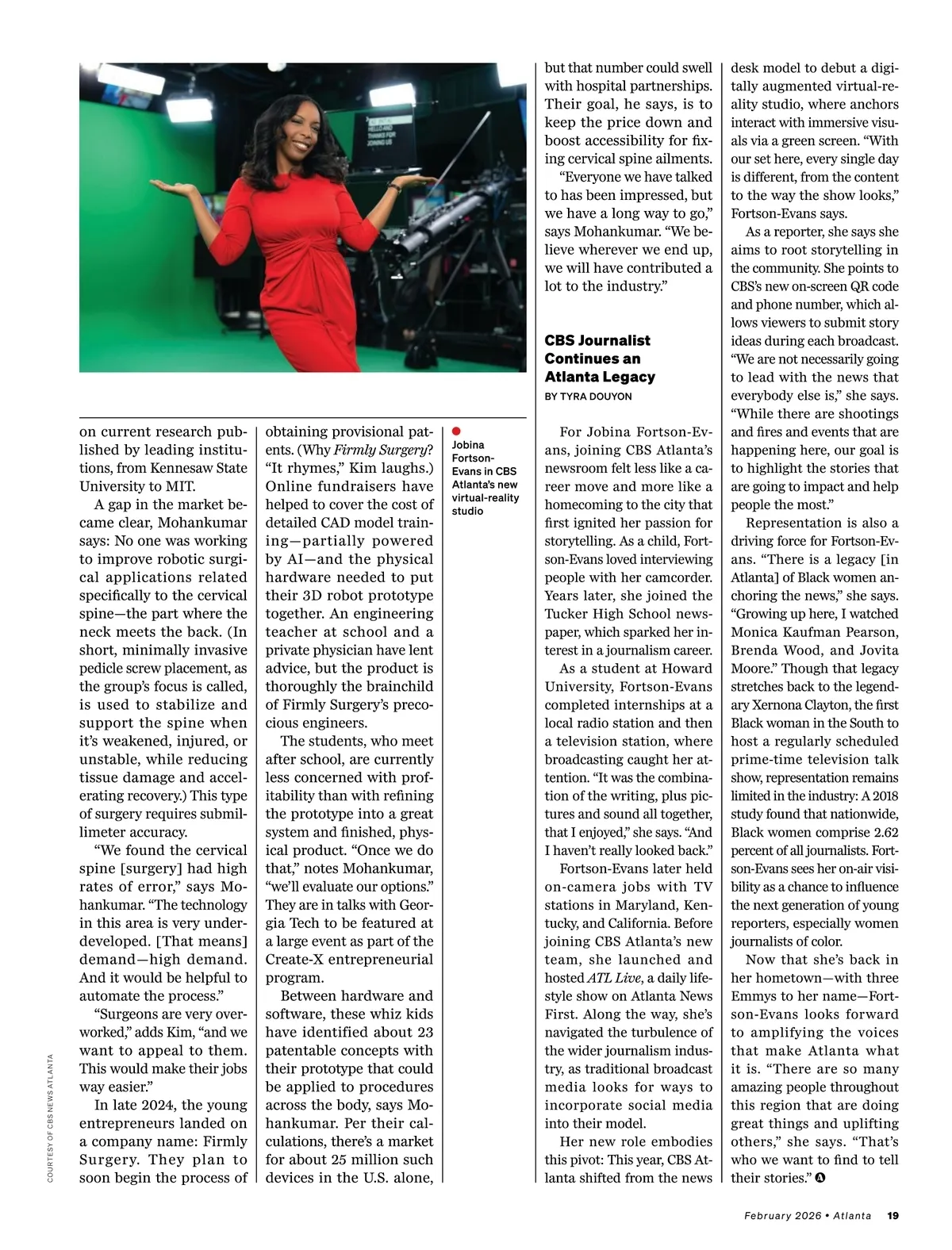
Connector OUT & ABOUT Field Notes Welcome, Waymo. Teen dream engineering team. A homegrown reporting star returns. driver, and no tipping. She appreciates the solo ride—a first for her. “I think a lot of people who drive are afraid of self-driving cars because they don’t have control,” Rogers says. “But I’ve never had control because I’m blind.” Atlanta is among the first cities in the country to offer Waymo, along with San Francisco, Los Ange-les, Austin, and Phoenix. Though the software com-pany has its own app in certain markets, it’s been using Uber as a platform to introduce Atlantans to Waymo; an option in the app’s settings allows users to opt for the autonomous ride. Waymo’s Atlanta fleet consists of about 100 ve-hicles, and the company plans to add more over the next few years. 02.26 Reinvented Wheel BY DENISE K. JAMES Because she’s legally blind and doesn’t drive, Lee Rog-ers has always used ride-share to navigate the city. A Candler Park resident, Rogers has been enjoying a new experience: being alone in the car, ferried to her destination by a driv-erless Waymo. The autono-mous vehicles, which have been available through the Uber app since June 2025, cover about 65 square miles of intown Atlanta. Rogers has come to prefer Waymo to traditional ride-share options, citing bene-fits such as safety, cleaner cars, no small talk with a By now, most Atlantans have experienced the strange jolt of seeing a car driving without a driver. “Waymo chose Atlanta almost two years ago be-cause of the rideshare de-mand,” says Ethan Teicher, a spokesperson for Waymo. Teicher says Miami is the company’s next target mar-ket, with launches in other major cities soon to follow. Midtown resident Cator Sparks chose the Waymo option on Uber out of sheer curiosity. He’d been seeing the cars around town and was happy to discover they were clean and quiet. “I thought the Waymo was easy to operate,” he says. “I touched my phone to the door to unlock it and picked 1940s jazz out of the music options.” Still, some experiences with autonomous vehi-cles have resulted in frus-tration, and Rogers and Sparks say there’s room for improvement. “Waymo didn’t register that it had new passengers,” Sparks says of one recent ride. “We had to call for support, step out of the car, and give it a minute. Meanwhile, it blocked other cars from entering the parking lot.” Nationwide, Waymo cars and other autono-mous vehicles have come under scrutiny for failing to adhere to road safety laws such as stopping for school buses; some state legislatures have consid-ered tougher restrictions on driverless cars. Rogers acknowledges that the driverless ride still isn’t perfect. “But if I have a choice between an Uber and a Waymo,” she says, “I’m taking a Waymo.” Gwinnett County Whiz Kids BY JOSH GREEN At a time of life when many teenagers are more con-cerned with earning driv-er’s licenses and scoring six-packs, three Suwanee high schoolers are busy in-venting a next-generation surgical robotic system. From scratch. In their spare time. Barghavan Mohankumar, Brandon Kim, and Brandon Whitehead—all 17-year-old juniors at North Gwinnett High School—believe their computer-aided design, or CAD, models and proto-type could spark a medical breakthrough. Profession-als beyond their teachers are starting to take notice. Mohankumar, the team lead, started hanging out with Kim, the software specialist, and Whitehead, hardware aficionado, during their freshman year. The trio discussed big, entrepreneurial ideas. They brainstormed and sketched. They pooled al-lowance money. Finally, the teens settled on an idea: a medical robot that would help doctors with precision spinal surgery. Then came laborious re-search. The trio compiled a 40-page document list-ing every design patent in the field of spinal surgery tools, surveyed the work of high-school robotics teams across Georgia, and read up 18 Atlanta • February 2026 C O U R T E S Y O F W AY M O A N D U B E R
Atlanta Magazine Atlanta Magazine February 2026: Page 18