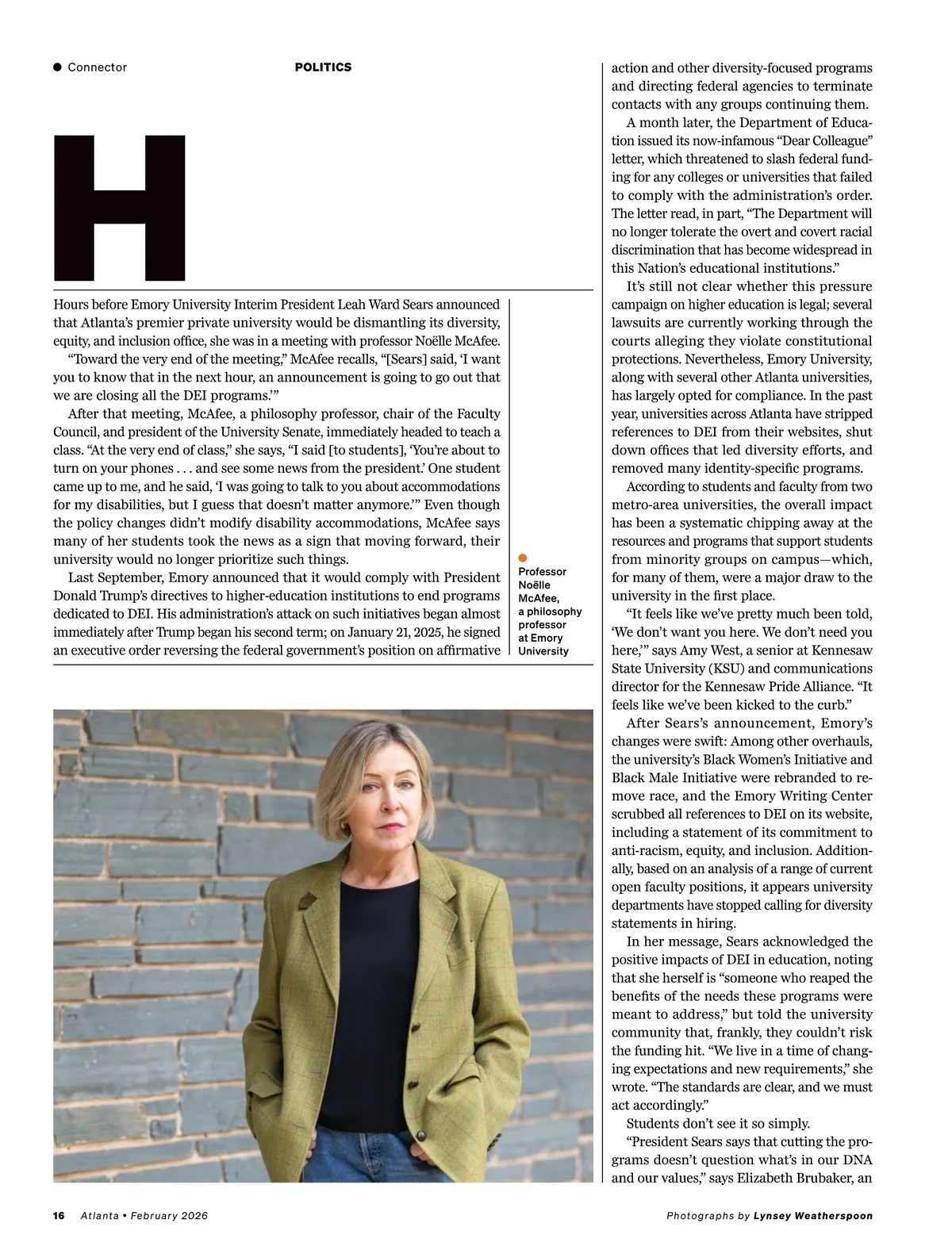
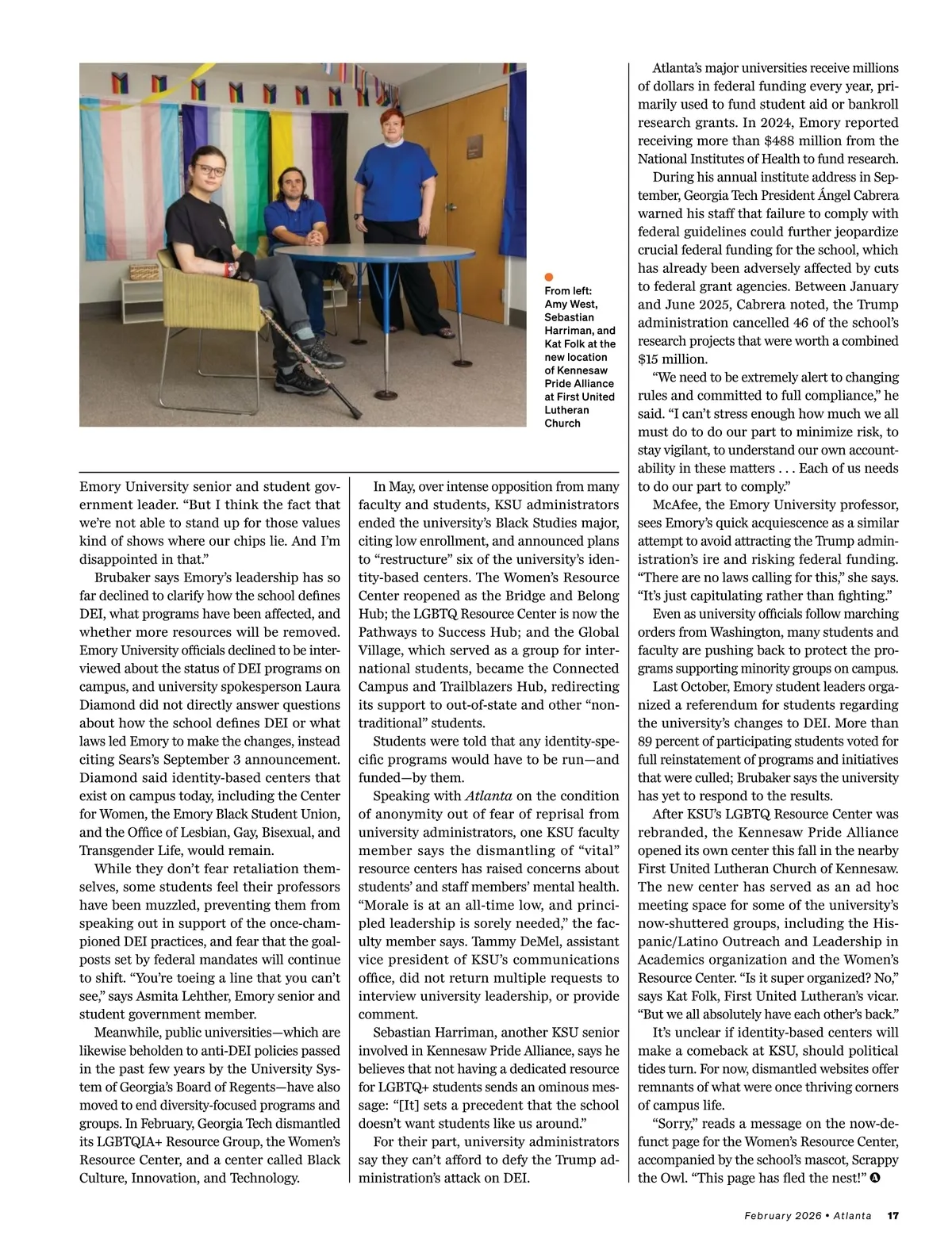
From left: Amy West, Sebastian Harriman, and Kat Folk at the new location of Kennesaw Pride Alliance at First United Lutheran Church Emory University senior and student gov-ernment leader. “But I think the fact that we’re not able to stand up for those values kind of shows where our chips lie. And I’m disappointed in that.” Brubaker says Emory’s leadership has so far declined to clarify how the school defines DEI, what programs have been affected, and whether more resources will be removed. Emory University officials declined to be inter-viewed about the status of DEI programs on campus, and university spokesperson Laura Diamond did not directly answer questions about how the school defines DEI or what laws led Emory to make the changes, instead citing Sears’s September 3 announcement. Diamond said identity-based centers that exist on campus today, including the Center for Women, the Emory Black Student Union, and the Office of Lesbian, Gay, Bisexual, and Transgender Life, would remain. While they don’t fear retaliation them-selves, some students feel their professors have been muzzled, preventing them from speaking out in support of the once-cham-pioned DEI practices, and fear that the goal-posts set by federal mandates will continue to shift. “You’re toeing a line that you can’t see,” says Asmita Lehther, Emory senior and student government member. Meanwhile, public universities—which are likewise beholden to anti-DEI policies passed in the past few years by the University Sys-tem of Georgia’s Board of Regents—have also moved to end diversity-focused programs and groups. In February, Georgia Tech dismantled its LGBTQIA+ Resource Group, the Women’s Resource Center, and a center called Black Culture, Innovation, and Technology. In May, over intense opposition from many faculty and students, KSU administrators ended the university’s Black Studies major, citing low enrollment, and announced plans to “restructure” six of the university’s iden-tity-based centers. The Women’s Resource Center reopened as the Bridge and Belong Hub; the LGBTQ Resource Center is now the Pathways to Success Hub; and the Global Village, which served as a group for inter-national students, became the Connected Campus and Trailblazers Hub, redirecting its support to out-of-state and other “non-traditional” students. Students were told that any identity-spe-cific programs would have to be run—and funded—by them. Speaking with Atlanta on the condition of anonymity out of fear of reprisal from university administrators, one KSU faculty member says the dismantling of “vital” resource centers has raised concerns about students’ and staff members’ mental health. “Morale is at an all-time low, and princi-pled leadership is sorely needed,” the fac-ulty member says. Tammy DeMel, assistant vice president of KSU’s communications office, did not return multiple requests to interview university leadership, or provide comment. Sebastian Harriman, another KSU senior involved in Kennesaw Pride Alliance, says he believes that not having a dedicated resource for LGBTQ+ students sends an ominous mes-sage: “[It] sets a precedent that the school doesn’t want students like us around.” For their part, university administrators say they can’t afford to defy the Trump ad-ministration’s attack on DEI. Atlanta’s major universities receive millions of dollars in federal funding every year, pri-marily used to fund student aid or bankroll research grants. In 2024, Emory reported receiving more than $488 million from the National Institutes of Health to fund research. During his annual institute address in Sep-tember, Georgia Tech President Ángel Cabrera warned his staff that failure to comply with federal guidelines could further jeopardize crucial federal funding for the school, which has already been adversely affected by cuts to federal grant agencies. Between January and June 2025, Cabrera noted, the Trump administration cancelled 46 of the school’s research projects that were worth a combined $15 million. “We need to be extremely alert to changing rules and committed to full compliance,” he said. “I can’t stress enough how much we all must do to do our part to minimize risk, to stay vigilant, to understand our own account-ability in these matters . . . Each of us needs to do our part to comply.” McAfee, the Emory University professor, sees Emory’s quick acquiescence as a similar attempt to avoid attracting the Trump admin-istration’s ire and risking federal funding. “There are no laws calling for this,” she says. “It’s just capitulating rather than fighting.” Even as university officials follow marching orders from Washington, many students and faculty are pushing back to protect the pro-grams supporting minority groups on campus. Last October, Emory student leaders orga-nized a referendum for students regarding the university’s changes to DEI. More than 89 percent of participating students voted for full reinstatement of programs and initiatives that were culled; Brubaker says the university has yet to respond to the results. After KSU’s LGBTQ Resource Center was rebranded, the Kennesaw Pride Alliance opened its own center this fall in the nearby First United Lutheran Church of Kennesaw. The new center has served as an ad hoc meeting space for some of the university’s now-shuttered groups, including the His-panic/Latino Outreach and Leadership in Academics organization and the Women’s Resource Center. “Is it super organized? No,” says Kat Folk, First United Lutheran’s vicar. “But we all absolutely have each other’s back.” It’s unclear if identity-based centers will make a comeback at KSU, should political tides turn. For now, dismantled websites offer remnants of what were once thriving corners of campus life. “Sorry,” reads a message on the now-de-funct page for the Women’s Resource Center, accompanied by the school’s mascot, Scrappy the Owl. “This page has fled the nest!” February 2026 • Atlanta 17
Atlanta Magazine Atlanta Magazine February 2026: Page 17